


Why Choose Us?
Professional Team
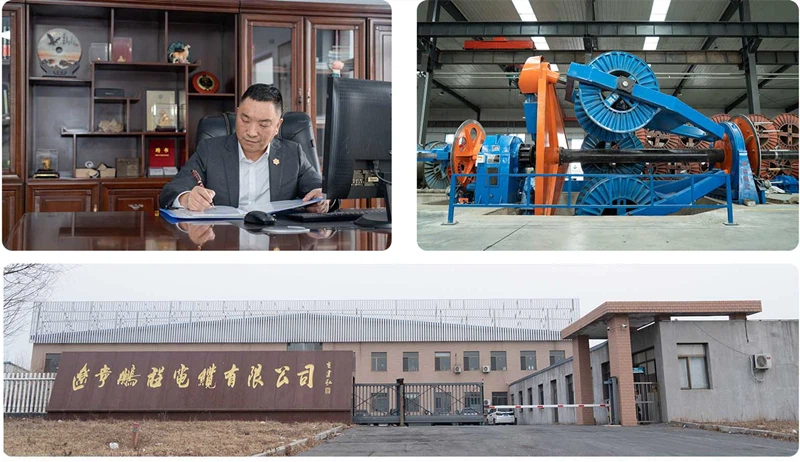
Liaoning Pengcheng Cable Co., Ltd. was founded in 1990. The company's R & D team is composed of experienced cable experts in the industry, and has independently developed a variety of high-tech special cable products.
Advanced Equipment
Pengcheng Cable has a number of international advanced production lines, modern factories, industrial parks of integrated wire and cable manufacturing enterprises.
Quality Control
The company's products have passed ISO9001/IATF16949 quality management system certification, ISO14001 environmental management system certification, ISO45001 Occupational health and safety management system certification, ISO10012 measurement management system certification and other 8 major management system certifications.
One-stop Solution
The company is mainly committed to research & development and production of flexible mineral insulated fireproof cables, mica belt mineral insulated corrugated copper sheathed cables, and new high conductivity 8000 series of anti-pressure and creep-resistant aluminum alloy core interlocking armored power cables, as well as halogen-free low-smoke flame retardant cables and ordinary wire and cable and other full range of full-specification high-quality cable products system research and development, design, manufacturing, marketing and service.
The 2.0 awg copper underground wire is generally used for the detection line of the fire automatic alarm system, electrical products, small power tools, instrumentation equipment and power lighting. It is used to connect the power amplifier and professional audio equipment. digital audio.

Underground Electrical Wire For 100 Amp Service
Copper core polyvinyl chloride insulated wire (BVR), bv wire is the type of wire, where b means cloth wire, V means the insulation material of the wire is polyvinyl chloride (also called PVC), r means soft wire.

Outdoor Underground Electrical Wire
Halogen-free low-smoke outdoor underground wiring. BYJ is a single-core wire, and BYJ is a cross-linked polyethylene insulated wire. The "B" indicates the insulated wire, and the "J" indicates the cross-linked electrical lead.

Underground Electrical Wire For House
Household underground laying network wire, digital communication six types of shielded twisted-pair cable, single strand bare copper wire, polyethylene insulation, two wires twisted pair, polyethylene, polyvinyl chloride or low smoke halogen-free flame retardant polyolefin sheath.

6/3 With Ground Direct Burial Wire
ZC-RVV wire is ground directly buried wire, in line with China's fire retardant c standard, RVV cable full name copper core PVC insulated PVC sheathed flexible wire, also known as light PVC sheathed flexible wire, commonly known as soft sheathed wire, is a kind of sheathed wire.

2.0 Awg Copper Underground Wire
RVS wire is the full name of copper core polyvinyl chloride insulated stranded connection with flexible wires, strands of flexible wire, the letter "R" means flexible wire, the letter "V" means polyvinyl chloride, that is, its material meaning, the letter "S" means "twisted pair" means.
2.0 awg copper underground wire is mostly used for the detector circuit of the fire alarm automatic alarm system.
Suitable for household appliances, small power tools, instrumentation and power lighting. Double white core is used for direct connection to the lamp line; red and blue core is used for fire protection, alarm, etc., red and white core is used for broadcasting and telephone line; red and black core is used for broadcasting line.
2.0 awg copper underground wire is used to connect the amplifier and audio equipment, and the broadcast system transmits the audio signal amplified by the power amplifier.
Stranded Vs. Solid Copper Underground Wires: The Key Differences
A comparison narrows down the choices based on how the specific copper underground wire characteristics relate to their expected use and the project requirements. You must first determine your application's requirements for weather resistance, flexibility, and resistance to splitting or severing. Then, choose the copper underground wire that most closely meets those needs.
Some key differences of stranded vs. Solid copper copper underground wire include:
Stranded vs. Solid copper underground wire current capacity. Solid copper underground wire is thicker, which means less surface area for dissipation. The thinner copper underground wires in stranded copper underground wire contain air gaps and greater surface area with the individual strands, translating to more dissipation. When choosing between solid or stranded copper underground wire for house wiring, the solid copper underground wire offers higher current capacity.
Routing. Stranded copper underground wires offer superior bendability and flexibility, making them easier to route around obstacles than solid copper underground wires.
Flexibility. Stranded copper underground wires are more flexible and can sustain more vibration and flexing without breaking. Solid copper underground wires may require more frequent replacement than stranded copper underground wires in applications with significant movement or vibrations.
Cost. The production costs of solid copper underground wire are much lower than stranded copper underground wire, which makes solid copper underground wire the more affordable choice.
Ease of manufacturing. The single-core nature of solid copper underground wire makes it much simpler to manufacture. Stranded copper underground wires require more complex manufacturing processes to twist the thinner copper underground wires together.
Distance. For longer runs, solid copper underground wires are the better choice because they feature less current dissipation. Stranded copper underground wire will perform well over shorter distances.
Superiority. When it comes down to stranded vs. Solid copper underground wire, there is no clear choice. Each option offers distinct advantages in particular situations.
Copper underground wires are known for their flexibility. The intertwining of copper wires creates a structure that allows for easy bending and maneuvering. This flexibility makes copper underground wires suitable for installations where space constraints or intricate routing is a concern.
In industrial settings, where the need for reliable and adaptable wiring is paramount, copper underground wires have become a staple. The flexibility of these cables ensures they can be easily routed through tight spaces, conduits, and around corners without compromising performance.

The Ubiquitous Presence of Copper Underground Wires
Construction and building industry
Flexibility and durability are crucial in the construction industry, where cables need to navigate tight spaces and withstand challenging conditions. Copper underground wires excel in these aspects, making them ideal for wiring in residential and commercial buildings.
Manufacturing and industrial facilities
In manufacturing environments, machinery and equipment require a stable power supply. Copper underground wires, with their high conductivity, ensure reliable connections to industrial machines, control panels, and motors. Their insulation protects against exposure to chemicals and oils often present in industrial settings.
Renewable energy projects
With the rise of renewable energy, the need for efficient power transmission has grown. Copper underground wires, with their copper conductors, minimize energy loss during transmission, making them the perfect choice for connecting solar panels and wind turbines.
Data centers and telecommunications
Data centers rely on copper underground wires for power distribution and connecting various equipment. Their flexibility and electrical performance ensure reliable data transmission, a critical requirement in the data-driven world.
Automotive and vehicle manufacturing
The flexibility and abrasion resistance of copper underground wires make them suitable for use in vehicle wiring harnesses. They contribute to the reliability and safety of automobiles.
Marine and nautical use
Copper underground wires' resistance to corrosion makes them ideal for marine applications. They are widely used in boats, yachts, and other watercraft for electrical connections, including navigation systems and lighting.
Agriculture and farming
In agriculture, where heavy machinery is commonplace, copper underground wires are utilized for power supply and control systems. They withstand the rigors of farming environments and provide durable electrical connections for machinery and pumps.
Why Do People Choose Copper Underground Wires
Difference in conductivity
The conductivity of aluminum is much lower than that of copper. Although aluminum core cables are lighter and cheaper, due to their poor conductivity, aluminum core cables with larger cross-sectional areas are required to transmit the same current. This not only increases the size and installation difficulty of the cable, but also leads to higher energy loss and reduces the efficiency of power transmission.
Inadequate mechanical properties
The mechanical strength of aluminum is lower than that of copper. Especially in the case of multiple bending and twisting, aluminum core cables are more prone to breakage and fatigue problems. In practical applications, this means that the reliability of aluminum core cables is far less than that of copper underground wires when facing complex installation environments and long-term use.
Contact problems
Aluminum is easily oxidized in the air to form a layer of aluminum oxide film, which has electrical insulation properties and may increase contact resistance, thereby causing poor contact problems. Copper is relatively stable and not easy to oxidize, so it can maintain good conductivity at joints and connections, reducing the failure rate.
Thermal expansion coefficient
The thermal expansion coefficient of aluminum is larger than that of copper. In an environment with large temperature changes, aluminum core cables are more likely to deform, resulting in loose joints, affecting the reliability and safety of the cable. This is particularly evident in high temperature or cold environments, increasing the frequency of maintenance and replacement.
Determine the electrical load
Start by calculating the electrical load or the total amount of power to be used in each circuit. Consider the number of outlets, lighting fixtures, and appliances likely to be connected to each circuit. It will help you determine the capacity or amperage rating required for the copper underground wire.
Check local electrical codes
Acquaint yourself with the local electrical codes and regulations. These codes specify the minimum requirements for wire for house wiring size, insulation, grounding, and installation methods. They ensure safety and adherence with the applicable standards.
Determine wire size
The circuit amperage rating and the wire run length the wire run determine the wire size. You can refer to the national electrical code or consult an electrician to determine the appropriate wire size. The wire size is usually specified in terms of american wire gauge (AWG). The larger numbers indicate smaller wire diameters.
Select the insulation type
Different insulation types are suitable for different environments and applications. The most common insulation types include:
●Thermoplastic: Suitable for general indoor use and dry locations.
●Thermoset: Suitable for indoor and outdoor use and provides better resistance to heat and moisture.
●Underground-rated: Designed for direct burial or underground installations and has moisture-resistant insulation.
Consider special requirements
Certain applications may require specialized wiring. If you have high-temperature environments, you may need home wiring cable with insulation capable of withstanding elevated temperatures. Additionally, low-voltage applications such as doorbells or security systems may require specific wiring designed for low voltage.
Our Factory
Liaoning Pengcheng Cable Co., Ltd. was founded in 1990, located in the northeast center of Shenyang & Tieling business district, is the comprehensive strength of the forefront of wire and cable manufacturing enterprises. Pengcheng Cable has a number of international advanced production lines, modern factories, industrial parks of integrated wire and cable manufacturing enterprises. The company is now located in Xintaizi Industrial Park, Liaoning Province, covering an area of nearly 150 acres, the factory area more than 50 acres. The company is mainly committed to research & development and production of flexible mineral insulated fireproof cables, mica belt mineral insulated corrugated copper sheathed cables, and new high conductivity 8000 series of anti-pressure and creep-resistant aluminum alloy core interlocking armored power cables, as well as halogen-free low-smoke flame retardant cables and ordinary wire and cable and other full range of full-specification high-quality cable products system research and development, design, manufacturing, marketing and service. Pengcheng products are widely used in smart grid, energy power, green building, smart factory and hospital and other fields. Currently has a number of valid patents.

Our Certificate
The company's products have passed ISO9001/IATF16949 quality management system certification, ISO14001 environmental management system certification, ISO45001 Occupational health and safety management system certification, ISO10012 measurement management system certification and other 8 major management system certifications. As well as the national industrial product production license, national mandatory product certification (3C certification), PCCC certification and China Quality CQC certification, flame retardant label certification, fire retardant label certification and other certifications.

FAQ
Hot Tags: 2.0 awg copper underground wire, China 2.0 awg copper underground wire manufacturers, suppliers, factory, buried electrical wire for underground power supply systems, underground electrical wire magnetic field, underground electrical wire certification, buried electrical wire for power distribution, underground electrical wire volume resistivity, buried electrical wire for underground electrical power lines


