


Screened Control Cable
Shenyang Pengcheng Haoyu Technology Co., Ltd
Liaoning Pengcheng Cable Co., Ltd. was founded in 1990, located in the northeast center of Shenyang & Tieling business district, is the comprehensive strength of the forefront of wire and cable manufacturing enterprises.
Why Choose Us
Quality assurance
We have 100% quality guarantee to customers. We will be responsible for any quality problem.
Good service
High-quality after-sales service, tracking usage, and positive feedback. Rapid response within 24 hours.
Fast delivery
We have full stock, and can deliver within short time. Many styles for your choices.
Reasonable price
Good Quality + Factory Price + Quick Response + Reliable Service, is what we are trying best to offer you.
Oem/odm
When you put forward your needs, our engineers will provide you with faster and more perfect customized solutions.
Efficient and convenient
The company has established marketing networks around the world to provide high-quality services to customers in an efficient and convenient manner.


Screened cable is used in a wide range of applications where electromagnetic interference (EMI) and radio frequency interference (RFI) can cause problems. Some common uses include:
Audio and video equipment
Medical equipment
Military communication systems
Industrial machinery
Aerospace and aviation applications
Advantages:
Screened cable offers several advantages over unshielded cable:
Better protection against electromagnetic interference (EMI) and radio frequency interference (RFI)
Reduced signal distortion and noise
Improved signal quality and reliability
Greater transmission distances
Increased durability and longevity

Types of Screened Cable
There are several types of screened cable, including:
Coaxial Cable
A type of cable with a central conductor surrounded by an insulating layer, a braided wire mesh, and an outer insulating layer.
Twisted Pair Cable
A type of cable with two insulated conductors that are twisted together, surrounded by a braided wire mesh or foil wrap.
Multi-Conductor Cable
A cable with multiple insulated conductors, each surrounded by its own braided wire mesh or foil wrap, and an overall outer layer of braided wire mesh or foil wrap.
Instrumentation Cable
A cable with multiple insulated conductors, each surrounded by a separate braided wire mesh or foil wrap.
Principle and Structure of Screened Control Cable
About the Screened Control Cable
The Screened Control Cable is a transmission line that uses a metal mesh braid to wrap the signal line, and the braid is generally red copper or tinned copper. The Screened Control Cable is a wire with a metal braided shell specially used to reduce the influence of external electromagnetic fields on the power supply or communication lines. This Screened Control Cable also has the effect of preventing the line from radiating electromagnetic energy to the outside. The shielding layer needs to be grounded, and external interference signals can be guided to the ground by this layer.
The shielding layer of the Screened Control Cable is mainly made of non-magnetic materials such as copper and aluminum, and the thickness is very thin, which is much smaller than the skin depth of the metal material at the frequency of use (the so-called skin effect refers to the distribution of the current in the conductor cross-section with the frequency. The higher the frequency, the smaller the skin depth, that is, the higher the frequency, the weaker the penetration ability of electromagnetic waves), the effect of the shielding layer is not mainly due to the reflection of the electric field and magnetic field by the metal body itself, It is caused by absorption, but is caused by the grounding of the shielding layer. Different grounding forms will directly affect the shielding effect.
The shielding principle of the Screened Control Cable is different from the balanced cancellation principle of the twisted pair. The Screened Control Cable is to add one or two layers of aluminum foil to the outside of the four pairs of twisted pairs, using the reflection, absorption and skin effect principle of metal on electromagnetic waves. , effectively prevent external electromagnetic interference from entering the cable, and also prevent the internal signal from radiating out, interfering with the work of other equipment.
The structure of the Screened Control Cable
The conductor wrapped by the Screened Control Cable is called the shielding layer, which is generally conductive cloth, braided copper mesh or copper (aluminum) foil. Ordinary: insulating layer + shielding layer + wire. Advanced: Insulation layer + shield layer + signal wire + shield layer ground wire. The shield layer of the Screened Control Cable generally needs to be grounded. The function of the Screened Control Cable is to isolate the electromagnetic field noise source from the sensitive equipment and cut off the propagation path of the noise source.
Shielding is divided into active shielding and passive shielding. Active shielding is to prevent noise sources from radiating outward, and is shielding noise sources; passive shielding is to prevent sensitive equipment from being interfered by noise sources, and is shielding sensitive equipment. The shielding layer of the Screened Control Cable is not allowed to be grounded at multiple points, because different grounding points are always different, and there is a potential difference at each point. Such as multi-point grounding, the formation of current in the shielding layer, not only does not play the role of shielding, but introduces interference, especially in the occasions where the frequency converter is used a lot, the interference contains various high-order harmonic components, which has a greater impact, and should be specially noticed.
What is Difference Between a Screened and Sheath Cable?
Introduction
Differences between screened and sheath cables: In the world of cables and wiring, precision and understanding are paramount. Each component plays a crucial role in the transmission of power, data, or signals, and any variation can significantly impact performance. Two terms that often lead to confusion are "screened" and "sheath" cables.
Cables as Lifelines: In an era driven by data, communication, and energy, cables serve as the lifelines that connect our devices, power our homes, and enable global communication. Whether it's transmitting electricity, internet signals, or audio-visual data, cables are the unsung heroes behind our modern way of life.
Diverse Applications: Cables come in various forms and serve diverse applications. From electrical power cables that deliver electricity to homes and industries to data cables that facilitate high-speed internet and telecommunications, the world of cables is vast and multifaceted.
Reliability Matters: In critical applications, such as medical equipment, aerospace, or industrial automation, cable reliability is non-negotiable. A single cable failure can have far-reaching consequences, making it imperative to choose the right type of cable for the job.
Screened cables and sheath cables are two distinct types of cables used in various applications, each with its own specific purpose and characteristics. Here's a summary of the key differences between screened and sheath cables:
- Screened Cable:
Purpose: Screened cables are designed primarily to protect against electromagnetic interference (EMI) and radiofrequency interference (RFI). They are used when the integrity of the signal or data transmission is crucial.
Shielding: Screened cables have an additional layer of shielding, typically made of materials like aluminum foil or copper braid. This shielding surrounds the inner conductors or cores, creating a conductive barrier that intercepts and diverts external interference.
Grounding: To maximize the effectiveness of the shielding, screened cables often require grounding. The shielding layer is connected to a ground point to dissipate any intercepted interference.
Applications: Screened cables are commonly used in applications where signal integrity is paramount, such as aerospace, defense, medical equipment, and industrial automation.
- Sheath Cable
Purpose: Sheath cables, also known as jacketed cables, are designed primarily to provide protection and insulation for the inner conductors. They safeguard the cable from physical damage, moisture, chemicals, and environmental elements.
Outer Sheath: Sheath cables have an outer protective layer, often made of materials like PVC (polyvinyl chloride) or LSZH (low smoke zero halogen). This outer sheath serves as insulation and provides protection against external factors.
Insulation: The sheath layer serves as an insulating barrier between the inner conductors and the external environment, preventing electrical leakage and ensuring safety.
Applications: Sheath cables are versatile and find applications in a wide range of industries and scenarios, including building wiring, outdoor installations, industrial machinery, and more. They are chosen for their resistance to physical wear, moisture, and chemicals.
Screened Cables: Guarding Against Interference
Screened Cables Defined: A screened cable, often referred to as a shielded cable, is designed with an additional layer of shielding material that surrounds the inner conductors or cores. This shielding serves as a barrier, protecting the signal or power transmission from external electromagnetic interference (EMI) or radiofrequency interference (RFI).
Choosing the Right Cable for Your Needs
The choice between screened and sheath cables hinges on the specific requirements of your application:
Screened Cables: Opt for screened cables when your priority is protecting signal integrity from electromagnetic or radiofrequency interference. Common applications include aerospace, medical equipment, and industrial automation.
Sheath Cables: Choose sheath cables when your focus is on environmental protection, insulation, and physical durability. Applications range from building wiring to outdoor installations and industrial settings.
Shielded Cable: When To Use
Electromagnetic interference (EMI) is prevalent throughout the factory floor. This is why data and signal cables are usually protected with insulated conductors and wrapped with a conductive layer. Shielding reduces electrical noise and reduces its impact on signals and also lowers electromagnetic radiation. Shielding prevents crosstalk between cables near each other. Shielding not only protects cable but it can also protect machinery and people as well.
Constructed to be electromagnetic compatible (EMC) to minimize noise generation, which affects many other systems like radio and data communication.
Communication cables are shielded to prevent the effects on the data transmitted from EMI. To further prevent cross talk and coupling, communication cables are also paired and individually shielded.
In some applications, such as those needing servo cables, double or even triple shielding is required: Around individual conductors, around twisted pairs, and around the entire cable.
Some applications do not require shielded cables. For example, if a cable will be used in a cabinet or otherwise away from other sources of noise, it does not need to be shielded, as it will be protected from noise and EMI already.
Cable shielding uses either a braided, spiral design or metal-coated Mylar or foil shield. The shielding wraps around each conductor to mitigate noise by 85% to 100%, depending on the configuration. The maximum shielding a braided shield can have is 90%. Spiral shields can offer 98%, while metal-coated Mylar can deflect 100% of EMI.
Using a thin layer of Mylar or aluminum foil eliminates the gaps you may encounter with braided designs. The foil is attached to a polyester backing to provide 100% coverage. However, because it is thin, it can make applying connectors a challenge. Foil shielding can also be damaged in high-flex applications, so spiral or braided designs work best there.
Just as described, braided shielding is made of a mesh of bare or tinned copper wires woven together. It is easy to terminate when crimping or soldering a connector. Because of the braiding, small gaps of coverage do occur, thus resulting in the only 90% shield rating. If the cable is not moving or flexing, this coverage should be sufficient. However, the braided design does add cost and weight to the final design.
Besides the braid covering, the maximum admissible diameter of the single strand of braid and the angle of twist to the axial axis of the conductor are also determined in the manufacturing. The thinner the single strand and the smaller the angle of twist, the more flexible is the cable. However, the diameter of the single wire is restricted due to the mechanical requirements.
A cable shield consists of a respective amount of strands, depending on the braiding machine (16, 24, 32). The total amount of strands equals the number of strands in a braiding element times the amount of elements. The strand diameter, the angle of twist and the folding number also determine the density of a shield. The single strands are combined to make larger strands. The larger strands are then unwound from the coils and are mounted on special braiding machines for stranding construction around the conductors.
Connecting shielded cables: Certain designs accommodate crimping or soldering of connectors easier than others. However, it is important to note that the connector, too, must offer similar ratings as the cable for effective shielding. Finally, it is important the cable be grounded at one end to eliminate the potential for noise loops.
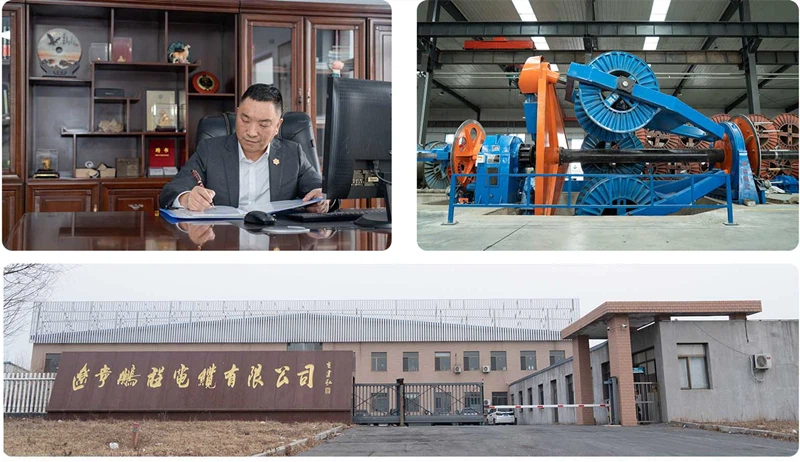
Our Factory
The company is now located in Xintaizi Industrial Park, Liaoning Province, covering an area of nearly 150 acres, the factory area more than 50 acres. The company is mainly committed to research & development and production of flexible mineral insulated fireproof cables, mica belt mineral insulated corrugated copper sheathed cables, and new high conductivity 8000 series of anti-pressure and creep-resistant aluminum alloy core interlocking armored power cables, as well as halogen-free low-smoke flame retardant cables and ordinary wire and cable and other full range of full-specification high-quality cable products system research and development, design, manufacturing, marketing and service. Pengcheng products are widely used in smart grid, energy power, green building, smart factory and hospital and other fields. Currently has a number of valid patents.

FAQ
We're professional screened control cable manufacturers and suppliers in China, specialized in providing high quality customized service. We warmly welcome you to buy cheap screened control cable for sale here and get pricelist from our factory. For price consultation, contact us.
control cable for reactive injection molding machines, control cable for equipment, control cable for actuators