Frequency is a fundamental electrical parameter that significantly impacts the performance of common house wire. As a supplier of common house wire, understanding these effects is crucial for providing high - quality products and advising customers on appropriate wire selection.
1. Resistance and Skin Effect
The resistance of a wire is a key factor in its performance, and frequency has a notable influence on it. At low frequencies, the current in a wire is distributed relatively uniformly across its cross - section. However, as the frequency increases, a phenomenon known as the skin effect comes into play.


The skin effect causes the current to concentrate near the outer surface (or "skin") of the wire. This is because the changing magnetic field associated with the alternating current induces eddy currents within the wire. These eddy currents oppose the flow of current in the inner part of the wire, effectively reducing the cross - sectional area through which the current can flow. As a result, the effective resistance of the wire increases with frequency.
For common house wire, which is typically used for power distribution at relatively low frequencies (e.g., 50 or 60 Hz in most household electrical systems), the skin effect is usually negligible. But in applications where higher frequencies are involved, such as in some home electronics or wireless charging systems, the increase in resistance due to the skin effect can lead to power losses and reduced efficiency.
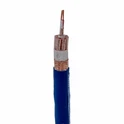
For example, in a high - frequency circuit within a smart home device, if a standard house wire is used, the increased resistance may cause the wire to heat up more than expected. This not only wastes energy but also poses a potential fire hazard. As a supplier, we need to be aware of these risks and recommend wires with appropriate characteristics for high - frequency applications. Our Copper Core Polyethylene Insulated Cable is designed to have better conductivity and can help mitigate the effects of the skin effect to some extent.
2. Capacitance and Dielectric Loss
Another aspect affected by frequency is the capacitance between the conductors in a house wire. When two conductors are in close proximity, they form a capacitor. The capacitance value depends on factors such as the distance between the conductors, the insulation material, and the surface area of the conductors.
As the frequency increases, the capacitive reactance ($X_C=\frac{1}{2\pi fC}$, where $f$ is the frequency and $C$ is the capacitance) decreases. This means that at higher frequencies, more current can flow through the capacitance between the conductors. This can lead to power losses in the form of dielectric losses within the insulation material.
The insulation material in house wire has a dielectric constant, which determines how much energy is stored and dissipated in the form of heat when an alternating electric field is applied. At higher frequencies, the dielectric losses increase because the molecules in the insulation material have to re - orient themselves more rapidly in response to the changing electric field.
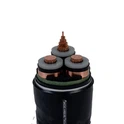
For instance, in a multi - core household wire like our 3 Core Household Wire, the capacitance between the cores can become a significant factor at high frequencies. Excessive dielectric losses can cause the wire to overheat and degrade the insulation over time, reducing the wire's lifespan and reliability.
3. Inductance and Inductive Reactance
Inductance is also an important property of house wire. When current flows through a wire, it creates a magnetic field around it. The magnetic field stores energy, and the wire has an inductance value ($L$). The inductive reactance ($X_L = 2\pi fL$) is directly proportional to the frequency.
At low frequencies, the inductive reactance is relatively small, and its effect on the wire's performance is minimal. However, as the frequency increases, the inductive reactance becomes more significant. This can cause a phase shift between the voltage and current in the wire, leading to power factor issues.
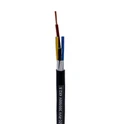
A low power factor means that the electrical system is not using the electrical energy efficiently. In a household, this can result in higher electricity bills because the utility company charges based on the apparent power (which includes both real and reactive power). As a supplier, we can educate our customers about these issues and recommend wires with lower inductance for applications where high - frequency currents are present. Our Household Insulated Wire is engineered to have optimized inductance characteristics to improve power factor and overall system efficiency.
4. Signal Transmission in House Wires
In addition to power distribution, house wires can also be used for signal transmission, such as in home automation systems or audio - visual installations. The frequency of the signals being transmitted has a profound impact on the wire's performance.
Higher - frequency signals are more susceptible to attenuation (loss of signal strength) and interference. The skin effect, capacitance, and inductance all contribute to signal attenuation. For example, in a home network using power - line communication (PLC), where data signals are transmitted over the existing electrical wiring, the frequency of the data signals needs to be carefully considered.
If the frequency is too high, the signal may be severely attenuated, resulting in poor data transfer rates or even signal loss. On the other hand, if the frequency is too low, the data transfer capacity will be limited. As a supplier, we can provide wires that are suitable for different signal frequencies, ensuring reliable communication within the household.
5. Selection of House Wire Based on Frequency
When selecting a house wire, the frequency of the electrical current or signal is a critical factor. For standard household power distribution at 50 or 60 Hz, a wide range of common house wires can be used. However, for applications with higher frequencies, more specialized wires are required.
For high - frequency power applications, wires with larger cross - sectional areas can help reduce the impact of the skin effect. Additionally, using wires with low - loss insulation materials can minimize dielectric losses. For signal transmission, shielded wires can be used to reduce interference and improve signal quality.
As a supplier, we offer a comprehensive range of house wires to meet different frequency requirements. Our technical team can provide expert advice to customers on wire selection based on their specific applications. Whether it's for a simple household lighting circuit or a complex home automation system, we can ensure that the right wire is chosen to optimize performance and safety.
Conclusion
The frequency of the electrical current or signal has a significant impact on the performance of common house wire. From resistance changes due to the skin effect to power losses from capacitance and inductance, and signal attenuation in data transmission, frequency affects various aspects of wire performance.
As a supplier of common house wire, we are committed to providing high - quality products and professional advice to our customers. We understand the importance of frequency in wire selection and offer a diverse range of wires to meet different needs. If you are in need of house wire for your project, whether it's a residential building or a commercial space, we invite you to contact us for procurement and discuss your specific requirements. Our team of experts will work closely with you to ensure that you get the best - suited wire for your application.
References
- Grover, F. W. (1946). Inductance Calculations: Working Formulas and Tables. Dover Publications.
- Nilsson, J. W., & Riedel, S. A. (2014). Electric Circuits. Pearson.
- Terman, F. E. (1955). Radio Engineers' Handbook. McGraw - Hill.